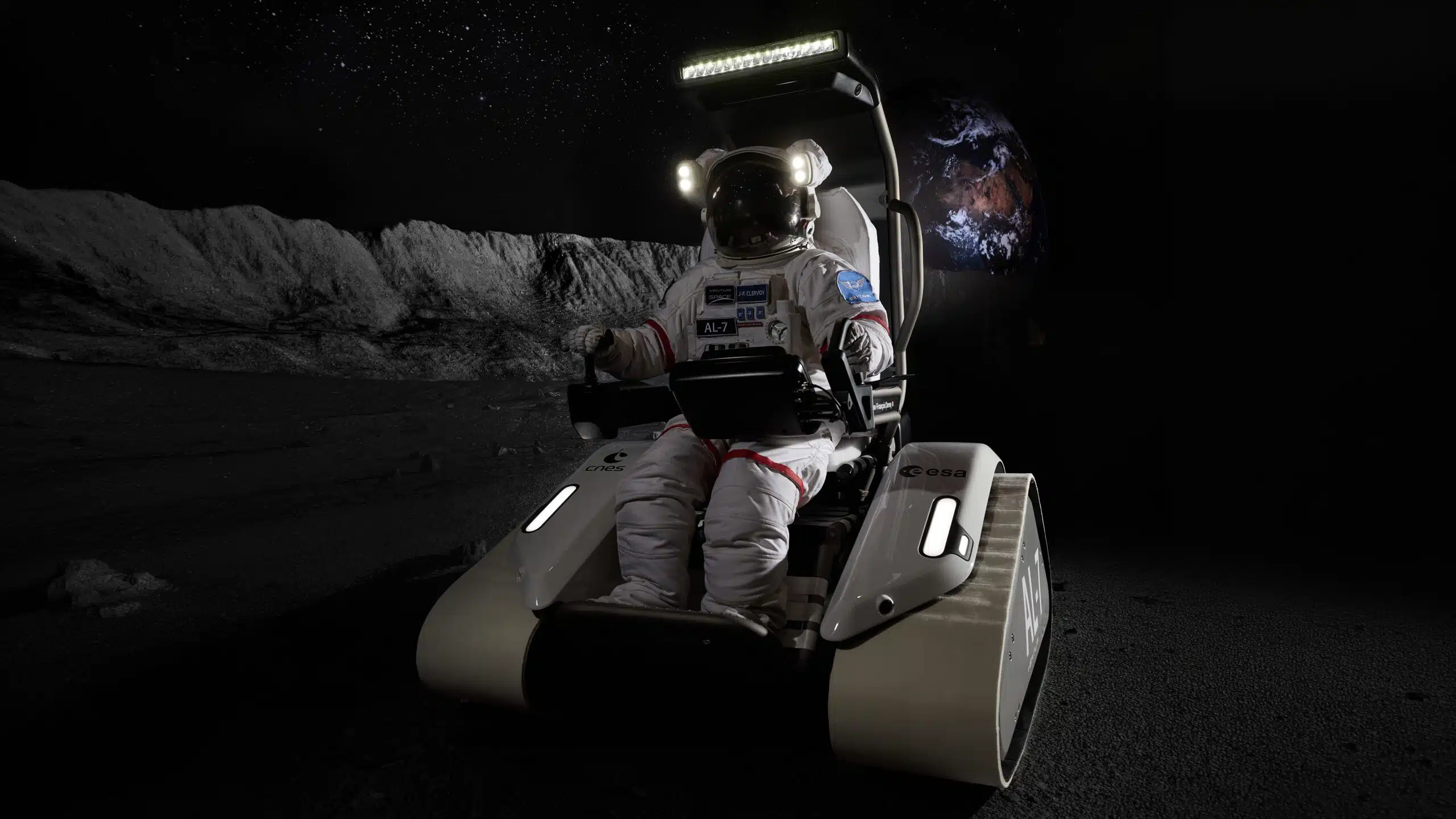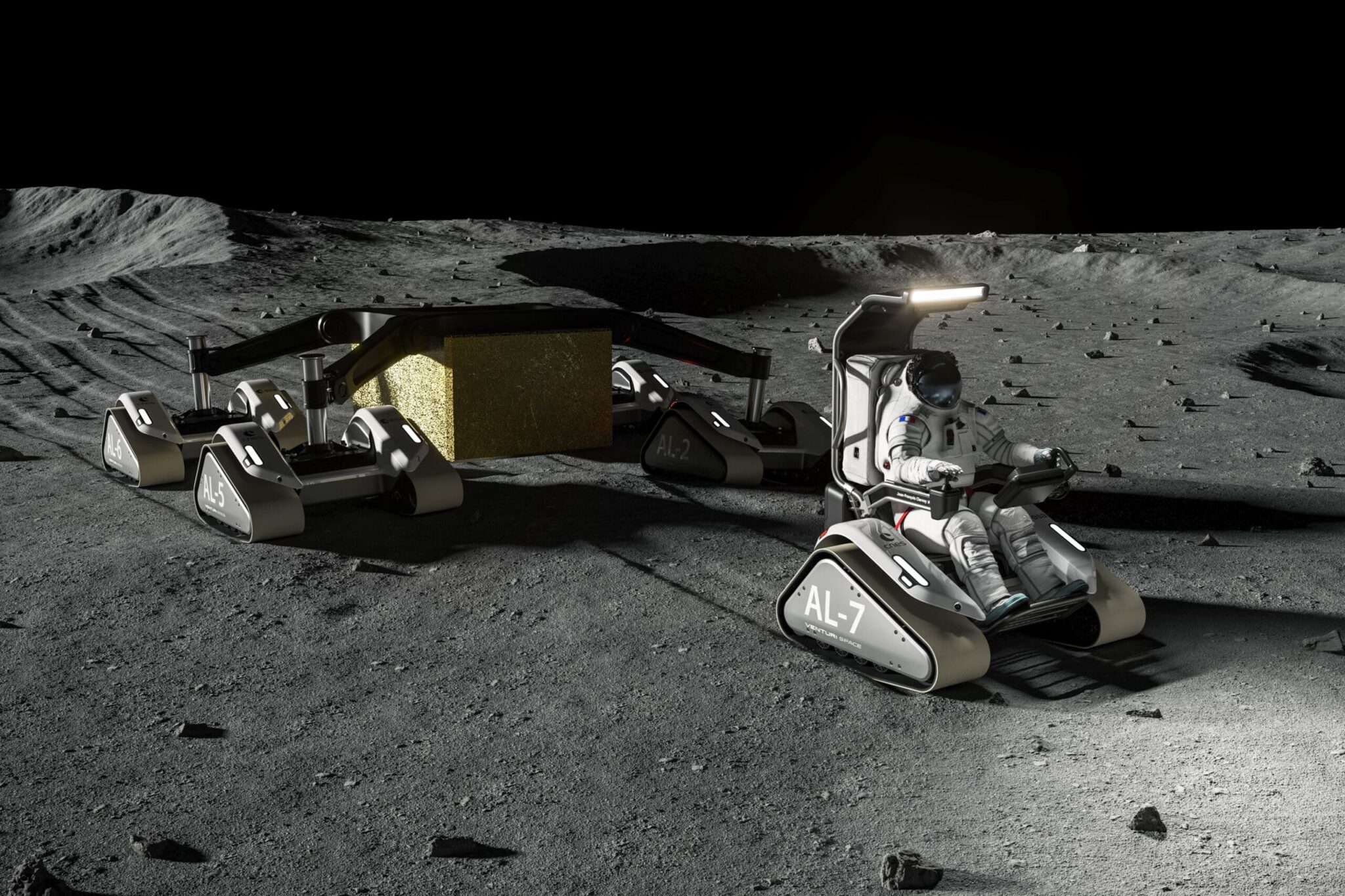
At its core, ALTA LUNA exemplifies functional compactness. Weighing just 300 kg, the vehicle prioritizes maneuverability and operational efficiency in the constrained environment of lunar habitats and their surrounding terrain. This design philosophy extends to capability—ALTA LUNA delivers exceptional obstacle-crossing performance, enabled by a tracked chassis architecture, a first for Venturi’s lunar programs. Unlike wheeled designs, the track system allows the vehicle to tackle steeper slopes, making it particularly suited to the varied topography of the lunar south pole region.
The vehicle operates in dual modes: crewed, with an astronaut aboard, or fully autonomous. In autonomous mode, ALTA LUNA relies on LiDAR, stereo cameras, and AI to navigate and execute complex tasks—excavation, site preparation, cargo transport, and infrastructure development. Multiple units can coordinate seamlessly, pooling resources for demanding operations.
Safety and integration are embedded into the design. The onboard electronics connect directly to the astronaut’s suit, monitoring vital health data. Should an emergency arise, ALTA LUNA can autonomously return the astronaut to base. The interface continuously communicates mission-critical information, from route optimization to space weather alerts.
ALTA LUNA shares Venturi Space’s proven battery and power management systems—the same technologies integrated into the CLV-1 rover, already selected by NASA for Artemis missions. This technical continuity underscores a deliberate design strategy: building a modular ecosystem of lunar mobility solutions.
As Venturi Space approaches the launch of FLIP to the lunar south pole and prepares for CLV-1’s 2028 deployment, ALTA LUNA signals the company’s expanding vision. The vehicle isn’t simply a tool; it’s a carefully considered response to the industrial demands of humanity’s return to the Moon—construction, logistics, maintenance, and connectivity all require specialized mobility. With ALTA LUNA, that next phase begins.